
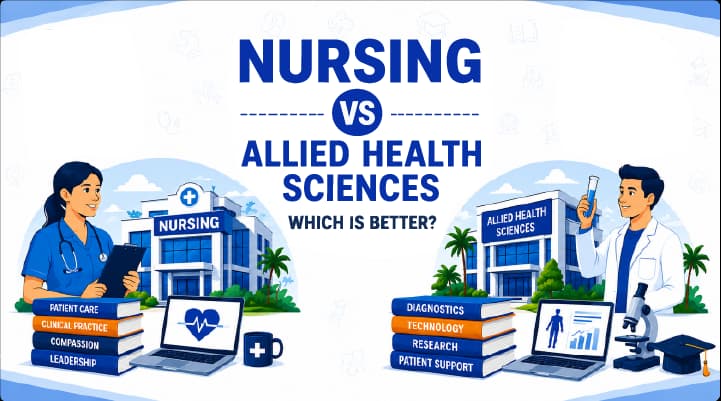
The healthcare field is among the most popular educational disciplines in India, witnessing lakhs of aspirants aiming to build a career in the diagnosis, treatment, and rehabilitation of patients. It is additionally a diverse field incorporating a wide range of career prospects in the areas of medicine, pharmacy, nursing, physiotherapy, and allied health sciences. Among these, the domains of Nursing and Allied Health Sciences have emerged as more sought-after options among aspirants. However, both fields have been overlooked over traditional medical courses.
While the MBBS degree is a leading path towards a medical career, nursing and allied medical sciences are equally important. Both serve as a backbone to the medical sector, contributing to patient health in unique ways.
Now you’re here wondering what is the better option of the two. At KeralaStudy, we present this blog to provide a comprehensive overview of the differences, features, and key facts about both fields, helping aspirants make informed career choices.
Nursing is a field that focuses on the overall care of patients admitted to a hospital. As a nurse, you are involved in monitoring, protecting and optimizing a patient’s health while collaborating with doctors to plan and execute treatments. You will be responsible for looking after patients, administering medicines, educating patients, and assisting doctors in treatments and emergency situations.
Nurses require skills like clinical assessment, medication administration, communication skills, patient monitoring, crisis control and time management. A nursing course provides students fundamentals in medical and clinical practices as well as midwifery and general healthcare.
Allied Health refers to the domains that assist doctors in diagnosing and treating patients. It is a crucial healthcare domain as it provides invaluable assistance to general physicians and surgeons. As an allied health professional, you are responsible for handling medical equipment or administering therapeutic methods to patients.
Professionals in allied health require skills such as clinical procedures, knowledge of medical technology, health informatics, crisis response, and infection control. Allied health courses offer a broader scope of learning that includes technical and management skills in addition to clinical proficiency.
Speaking of a broader scope, the field of allied health sciences comprises a variety of specialized areas that aspirants can choose to pursue. They include the following:
Medical Laboratory Technology
Anaesthesia & Operation Theatre Technology
Cardiovascular Technology
Medical Radiology & Imaging Technology
Respiratory Therapy
Emergency & Trauma Care Technology
Renal Dialysis Technology
Cardiac Care Technology
The following are top nursing courses after 12th one can enroll in:
Those interested in allied health can consider enrolling for the following allied health sciences degree courses below:
Curriculum: This includes fundamentals like anatomy, physiology, pathology, as well as nursing principles, community health nursing, midwifery, and specialized nursing. Internships are also included for practical training.
Admissions: The B.Sc Nursing admission requires a 10+2 with Biology and some colleges accept NEET-UG scores as well as centralized counselling or direct admissions.
Scope: The nursing scope in India is extensive with careers at hospitals, clinics, public health, defence, and railways with specializations in pediatrics, oncology, and psychiatry.
Work Environment: A nursing career enables you to interact with patients, constantly monitoring their health and working with doctors to treat patients.
Salary: The nursing salary can depend on the recruiter, job role and experience but on average ranges from Rs. 3 LPA to Rs. 14 LPA.
Career Opportunities: Nursing jobs are available across a diverse range of medical domains. Aspirants can land professional roles as a general nurse, ICU nurse, emergency nurse, senior nurse or a specialty nurse, among many other nursing career opportunities.
Patient Interaction: Very active with round-the-clock patient care, monitoring and education.
Curriculum: The allied health sciences syllabus covers basic anatomy, physiology, biotechnology, biochemistry but also focuses on medical technology, diagnostics, therapeutic methods and clinical assistance.
Admissions: The allied health science eligibility is the 10+2 with Biology and generally does not require an entrance exam of counselling.
Scope: The allied health sciences scope offers career opportunities at hospitals, speciality clinics, rehabilitation centres, and medical tech to handle equipment or specialize in non-physician roles.
Work Environment: Allied health professionals are surrounded by medical technologies such as X-rays, MRI scans, and CT scans. They can also specialize in therapeutic procedures for long-term patient interaction.
Salary: The allied health sciences salary in India can range from Rs. 4 LPA to Rs. 15 LPA depending on recruiter, experience and job role.
Career Opportunities: Allied health sciences career opportunities include medical lab, cardiovascular, operation theatre and respiratory technicians along with physiotherapists, occupational therapists and audiologists.
Patient Interaction: Depends on specialization as therapist jobs involve patient interactions whereas those handling medical technology is minimal.
Note: The nursing course fees provided above are estimates and may depend on the seat quota and course degree level of the respective colleges.
Note: The allied health sciences fees provided above may vary depending on the seat quota and degree level.
So, which course is best after 12th PCB in the medical sector: Nursing or Allied Health? The answer truly depends on your career preferences, skills, interests and your aspirations.
Choose nursing if you love to interact with patients, are compassionate and empathetic, and can manage fast-paced work environments.
On the other hand, choose allied health sciences if you are tech-savvy, prefer to land specialized roles or simply wish to pursue a non-medical career in the healthcare sector.
It is not a question of which is the ‘better’ option, it is whether your interest, personality and skills line up with either of the streams. And it is only appropriate that you choose the course that suits you well and lead you to a career that you will excel in and genuinely enjoy.
It depends on the preference but the popular courses in both Nursing and Allied Health are B.Sc Nursing and B.Sc Allied Health Sciences.
The eligibility depends on degree level but the UG eligibility for nursing and allied health required 10+2 with Physics, Chemistry and Biology.
B.Sc Nursing requires NEET-UG at some colleges whereas B.Sc Allied Health Science does not generally require centralized entrance tests.
The salary for nursing ranges from Rs. 3 LPA to Rs. 14 LPA whereas allied health salary ranges from Rs. 4 LPA to Rs. 15 LPA.
Nursing jobs include being a nurse in general, critical care, pediatric and administrative domains whereas allied health jobs include technicians for medical equipment or therapists for physiology and occupational therapy.
Nursing fees can range from Rs. 20,000 to Rs. 2,00,000 whereas Allied Health Sciences course fees range from Rs. 15,000 to Rs. 3,00,000.
Nursing enables you to interact with patients at all times whereas allied health therapists have more opportunities for the same compared to medical technicians.
Nursing provides patient interaction and collaboration with medical professionals whereas allied health has multiple specializations and technical careers.
The top nursing colleges in Kerala include Government Colleges of Nursing in Trivandrum and Kozhikode, Amrita School of Nursing Kochi, Jubilee Mission College of Nursing Thrissur and Baby Memorial College of Nursing Kozhikode.
Nursing focuses on direct patient care and recovery whereas Allied Health utilizes specialized medical technologies and clinical expertise to support the diagnosis, treatment and rehabilitation of patients. However, it is up to the aspirant’s interests and career goals to decide the best-suited option.